Admired, Cancelled and Rediscovered : The true story of Jacopone da Todi, c1270-2024. Part 2: Cancelled (c1590-1900)
For over three centuries after his death, Jacopone was widely admired and his laudi were highly regarded, both as religious poetry/songs and as texts for spiritual formation. This situation changed dramatically during the tumultuous 1500s, the period of the Protestant Reformation and the subsequent Catholic Counter-Reformation. This was followed by the darkest hour in the story of Jacopone: another period of over three centuries, from the end of the 1500s to the beginning of the 1900s, when the axe of the Counter-Reformation fell on Jacopone’s writing and the Curias of Rome and Todi sought to obliterate his memory. In modern terms, he was ‘cancelled’.
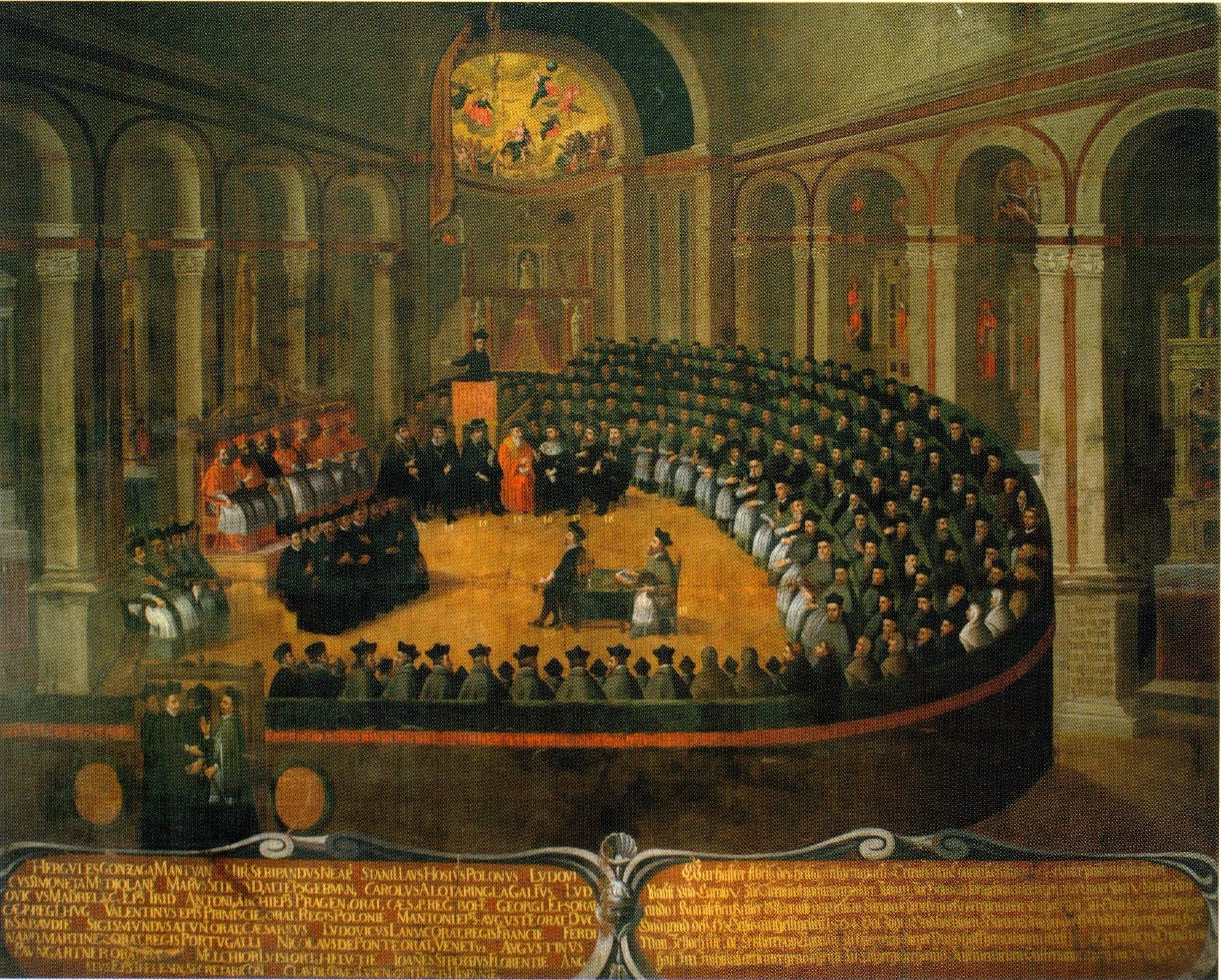
The Council of Trent. Elia Naurizio, CC BY-SA 3.0 <https://creativecommons.org/licenses/by-sa/3.0>, via Wikimedia Commons
Jacopone in the Counter-Reformation
The crisis that engulfed the Catholic Church in the mid-1500s did not come out of nowhere. Problems such as simony (sale of ecclesiastical offices) and the abuse of indulgences, relics and holy images had a long history: Jacopone had described them as “hypocrisies of all kinds”. Unfortunately for Jacopone, Martin Luther’s denunciations of such failings were reminiscent of his prophetic complaints over two centuries earlier. The Church's reaction to such criticism was to ‘double down’, reiterating its most controversial positions in the Council of Trent (1545-1563), so as to differentiate itself clearly from the new Protestant confessions. For the Counter-Reformation Church, conformity and loyalty were the highest values and in this suspicious and intolerant atmosphere, Jacopone’s criticism of corruption in the Church, his dispute with the Pope and his subsequent excommunication, became deeply problematic.
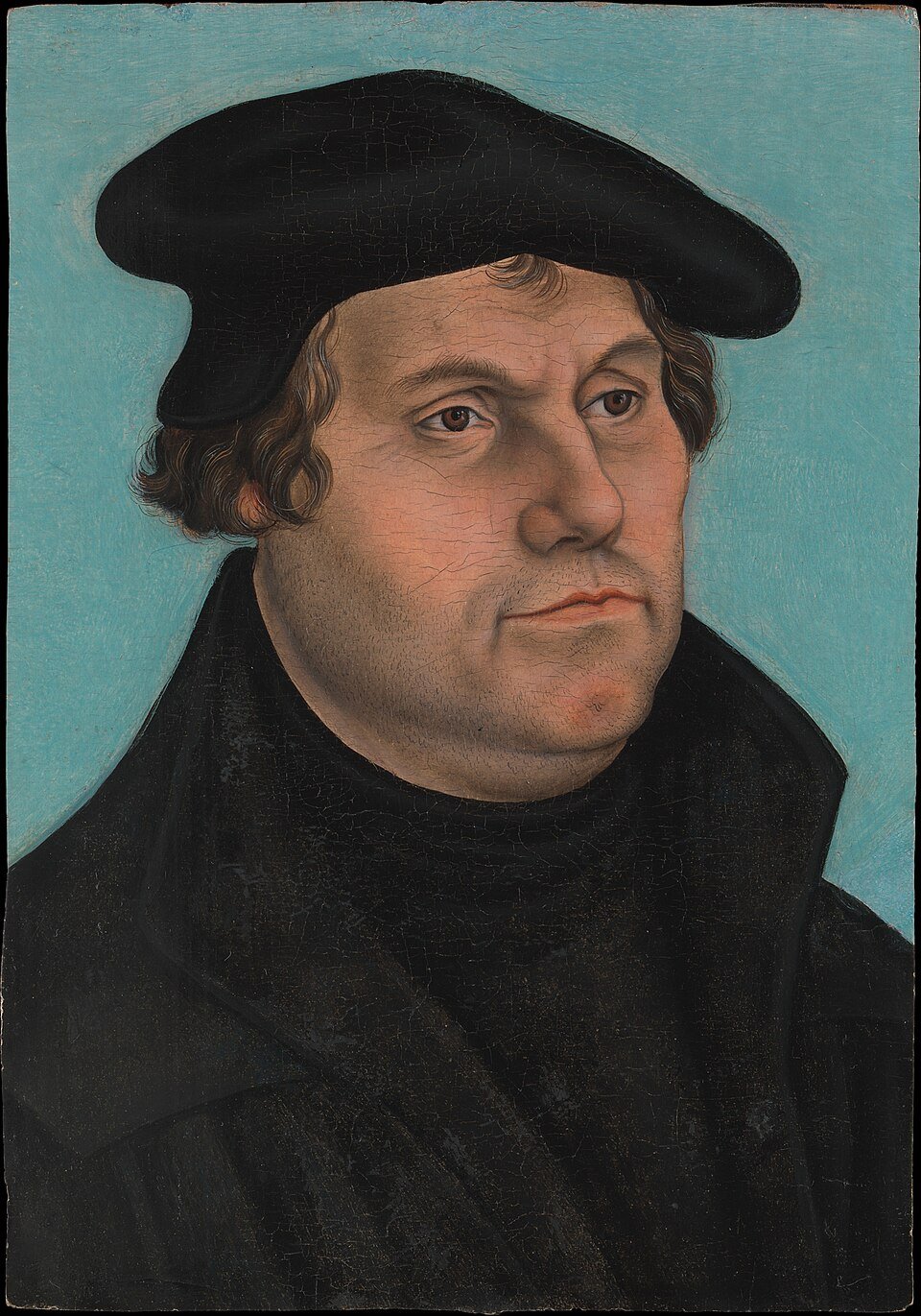
Martin Luther (1483–1546), workshop of Lucas Cranach the Elder, Metropolitan Museum of Art (CC0, via Wikimedia Commons)
Things came to a head in the 1590s through the activities of Angelo Cesi, bishop of Todi from 1566 to 1606. A recent biographer describes Cesi as a man who
was able to guide the mystical fervour of a people longing for moral and social stability along the tracks of the Catholic faith, thanks to the wise direction of grandiose religious apparatuses ... Bishop Angelo Cesi was able to channel the ‘religious delirium’ of the masses into activities celebrating both the Catholic faith and his own person.…
[Alessandro Fortunati, Angelus Cæsius Episcopvs Tvdertinvs. Todi, Tau Editrice, 2015].
In 1596 Bishop Cesi arranged for the relics of the “five patron saints” of Todi to be moved to an impressive new tomb, in a crypt under the high altar of the church of San Fortunato, accompanied by a week of elaborate ceremonials including a three hour-long procession through the city.
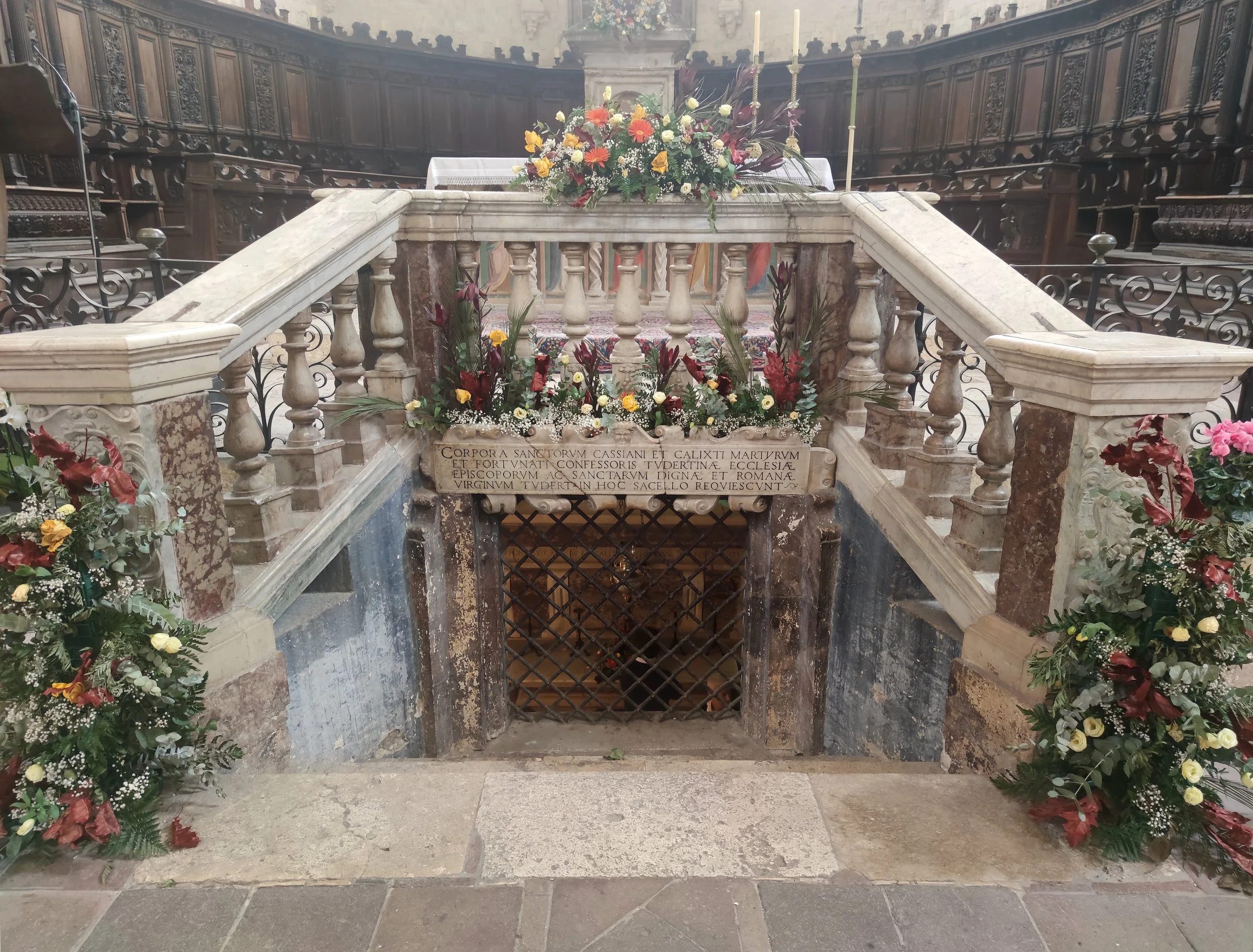
San Fortunato, Todi: Viewing grille in front of the high altar, opening onto the crypt inserted by Bishop Cesi in 1596. The inscription over the grille reads: “The bodies of Saints Cassian and Calyxtus, martyrs, and of Fortunato, bishop of the church of Todi and of Saints Digna and Romana, virgins of Todi, rest in this shrine”. Photo by Andy Halpin.
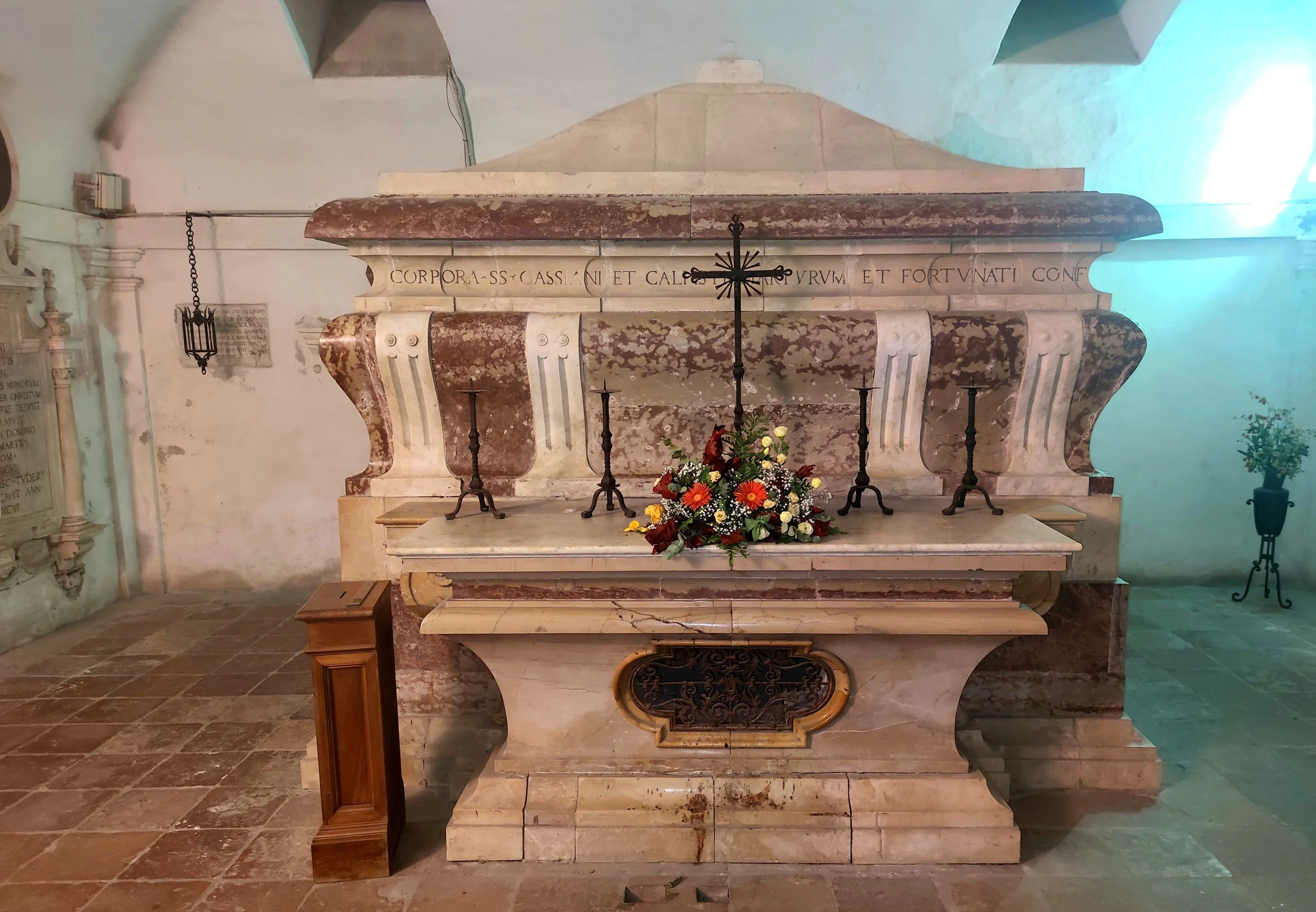
San Fortunato, Todi: The tomb of the “five patron saints” in Bishop Cesi’s crypt. The monument to Jacopone can be partly seen in the wall on the left. Photo by Andy Halpin.
Jacopone was not included among these patron saints but Bishop Cesi, knowing the devotion of the people of Todi for their great poet, was anxious to extend his patronage to Jacopone also. He may even have hoped to initiate a process of canonisation for Jacopone. But by this date Jacopone was viewed in the Roman Curia as a problematic, even dangerous figure, whose record of protest against Church authorities made them deeply uncomfortable. Bishop Cesi quickly realised that a change of approach was required. Jacopone’s remains were placed in the new crypt in San Fortunato, but not in the tomb of the ‘patron saints’. Instead, Cesi had them interred in a separate wall tomb, marked by a marble monument that is a masterpiece of political chicanery: While praising Jacopone’s art and his devotion to Christ, it records a false date of death (1296), effectively cancelling the final ten years of Jacopone’s life – the years of his protest, excommunication and imprisonment but also of his greatest poetic inspiration and spiritual fulfillment.
The ‘psychic murder’ of Jacopone
This monument is the physical symbol of what seems to have been a deliberate policy of the Church authorities, both in Todi and in Rome, to control and manipulate the memory of Jacopone by submerging it in what Giuseppe Ungaretti called the “edifying nonsense …. of a certain type of Franciscan hagiography”. From the end of the 1500s, the Curias of Todi and Rome seem to have orchestrated two convergent actions:
Firstly, change Jacopone’s biography to suit the demands of the Counter-Reformation Church: In 1597 Bishop Cesi formally approved a new biography of Jacopone by Giovanbattista Possevino. In time-honoured hagiographical tradition, the new biography combined devotion and invention to create a new Jacopone – a figure combining naive simplicity, bizarre eccentricity and fanatical extremism. Possevino, too, dates Jacopone’s death falsely to 1296, brutally eliminating any need to discuss Jacopone’s criticism of the Church of his time. This is a classic example of what Edgar Morin calls “psychic murder”: an effort to extinguish the victim's memory in oblivion or indifference. Jacopone became almost a figure of fun, even in his home town, and certainly a figure whose views, either on spirituality or on the Church, could safely be ignored.
Secondly, destroy all evidence of the real life and work of Jacopone. The almost total absence of any original documentation or evidence of Jacopone’s life, either in Todi or in Rome, is quite remarkable and can hardly be accidental. The extensive archives of the Church in Todi – and even more so, in the Vatican – apparently hold nothing relating to him. Not a single copy of Jacopone’s laudi remains in the archives of any diocese or parish in Italy, despite good evidence that they were widely read, prayed and sung during the three centuries prior to the Counter-Reformation. Even Francesco Bonaccorsi’s first printed Laudario of 1490 seems to have rapidly disappeared and been forgotten, so that only a handful of copies are known, anywhere in the world, today.
Don Mario Pericoli, a Todi priest, archivist and archaeologist, spent a lifetime searching for documents linked to Jacopone. In 1993 he wrote:
Friar Jacopone da Todi was and continues to be a troublesome personality: The excommunication of Boniface VIII continues in its deleterious effects …. A troublesome personality for the Franciscans and for anyone who has shown compassion or sympathy for him, for his writings or for anything related to his personality and his work. No-one, even to this date, has managed to uncover his autograph or anything else that may have belonged to him...
Another possible example of the destruction (or in this case, disguise) of first-hand evidence for Jacopone is the so-called Prison of St Cassiano in Todi.
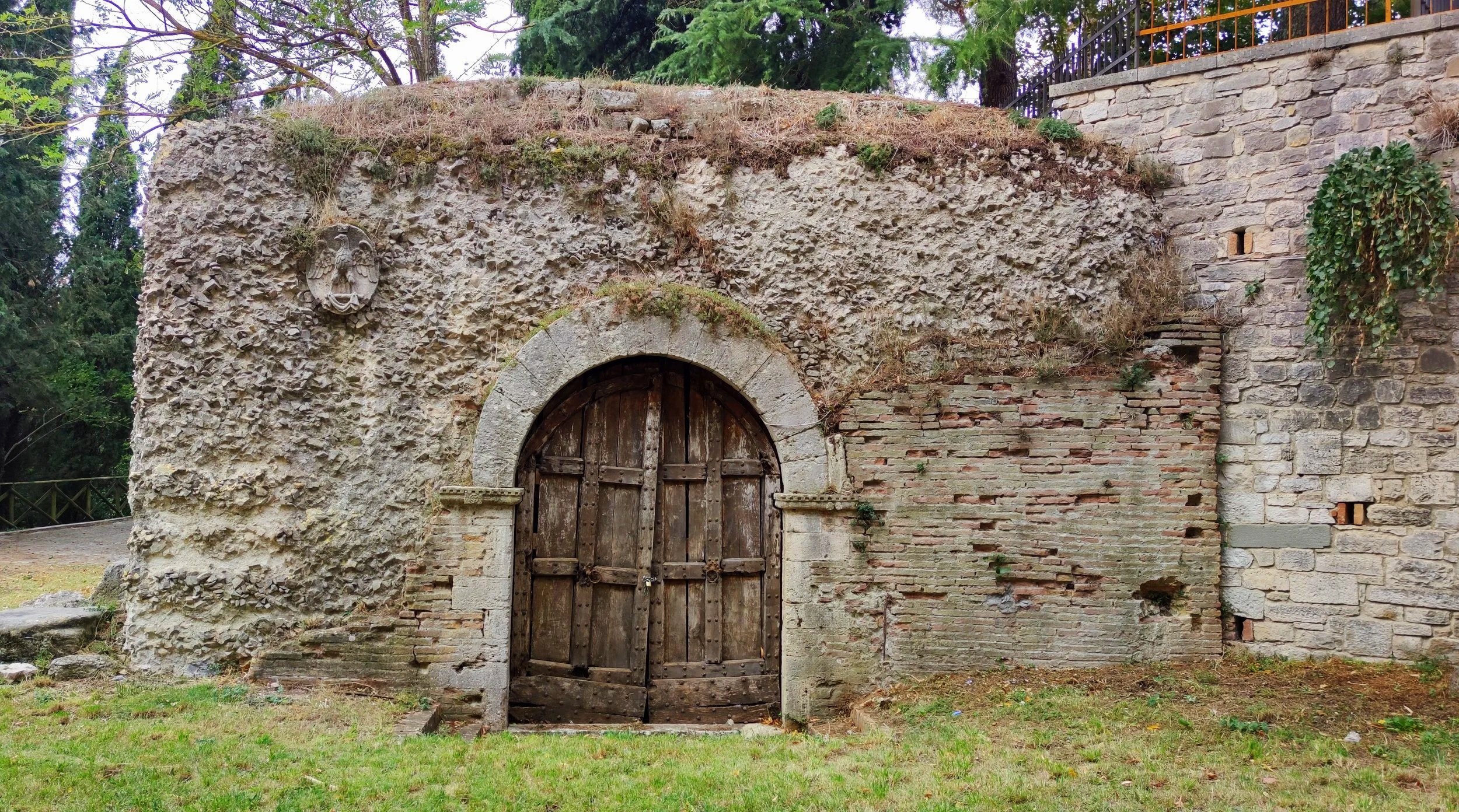
Prison of St Cassiano
Local tradition is that Cassiano, a 3rd-century bishop of Todi and one of the town’s five ‘patron saints’, was imprisoned prior to his martyrdom in this converted Roman cistern, which is now part of the convent of San Fortunato. But there is actually no reliable evidence that this Cassiano of Todi ever existed. He seems probably to be a confused reference to St Cassiano of Imola – who may have been venerated in Todi in the early Middle Ages but was certainly never imprisoned there. There is also no evidence for any tradition of Cassiano’s imprisonment in the cistern before the late 1500s. In fact, the legend is first recorded (by Possevino) in 1597 – precisely at the period when the life and death of Jacopone were being rewritten by the Church. The sudden appearance of this obviously unhistorical tradition about Cassiano, especially when linked to a real location, demands some explanation. It is difficult to avoid the conclusion that the legend of Cassiano may have been fabricated to obscure the identity of a genuine prisoner, held in San Fortunato and perhaps in that very cistern: Jacopone.
The loss of Jacopone’s voice
These developments had profound – and negative – implications, also, for literary research. The disappearance of Bonaccorsi’s Laudario effectively meant the loss of the authentic canon of Jacopone’s poetry. This is clearly seen by comparing Bonaccorsi’s edition of 1490 with another edition of Jacopone’s Laudario, published in 1617, in Venice, by the Franciscan Francesco Tresatti.
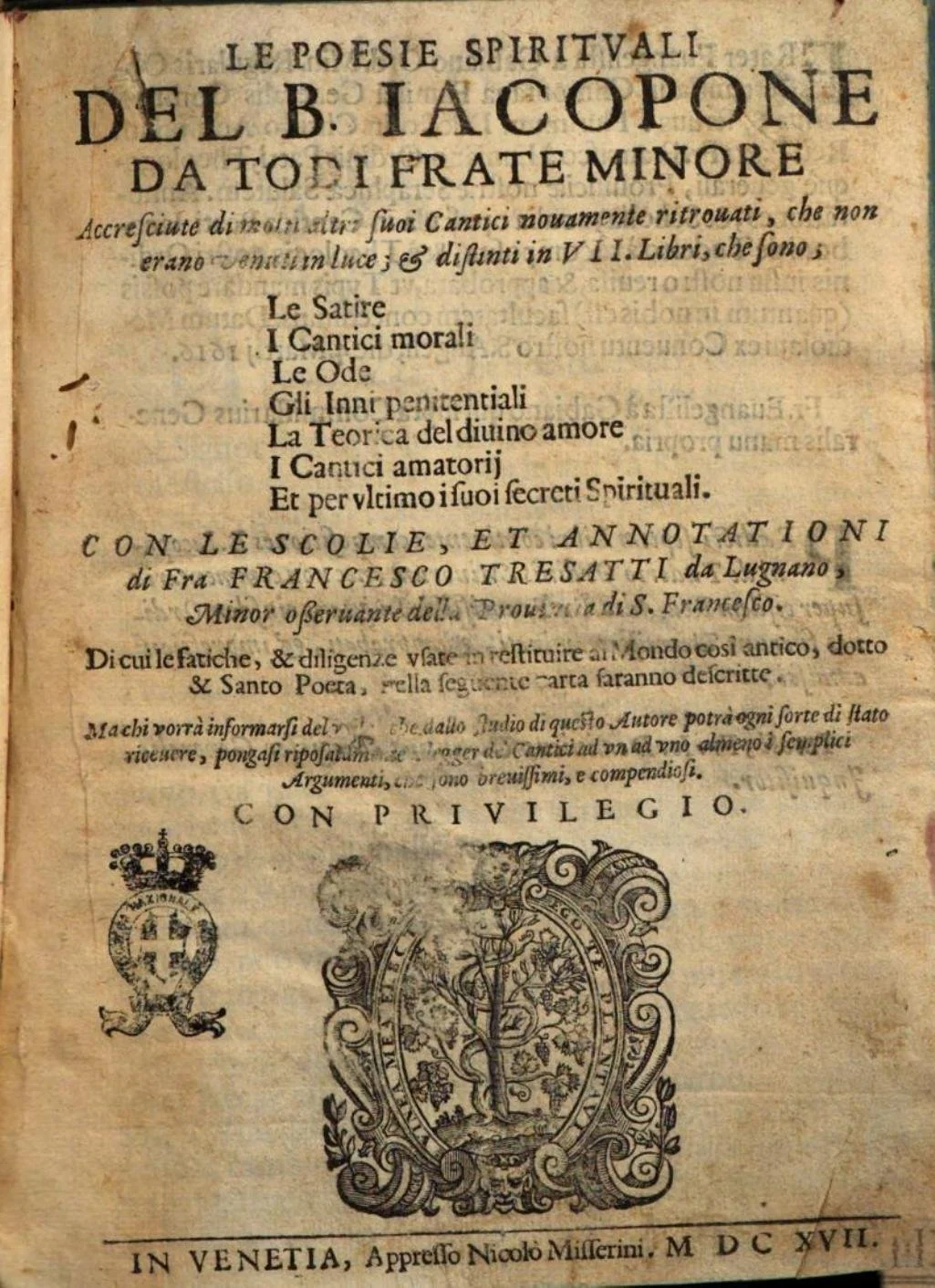
Title page of Tressatti’s edition of 1617
In 1490, Bonaccorsi’s edition contained 102 laudi, although Bonaccorsi expressed serious doubts about the authenticity of the final nine (laudi 94-102) and clearly considered only 93 laudi to be authentic. Today, it’s generally accepted that we have 92 authentic laudi of Jacopone. But in 1617 Tresatti’s edition contained 211 laudi – more than double the number included by Bonaccorsi! Remarkably, Jacopone’s authentic laudi were now in the minority and most of the laudi included by Tresatti were apocryphyal, later imitations, not actually written by Jacopone. And Tresatti himself seems to have been quite unaware of this. The suppression of the authoritative Laudario opened the door to such imitations, as well as alterations and destruction of genuine laudi, resulting in the loss of Jacopone’s authentic voice for over three centuries.
The effects of this situation were noted, in passing, in the Introduction to Serge and Elizabeth Hughes’ English edition of Jacopone’s laudi (published in New York in 1982). Discussing the influence of Francesco De Sanctis, “the critic who first introduced the Lauds [of Jacopone] to a wide literary public in his History of Italian Literature of 1860”, Hughes made a very pointed comment:
Had a critical text been available at the time, De Sanctis would have done better than to include twelve apocryphal lauds in the fourteen he chose to illustrate his points, and just as certainly he would have discarded the apocryphal proverbs he used to document the case he made for Jacopone’s penchant for folksy wisdom [our emphasis]
The significance of this statement is quite stark: By the late 1800s even a major figure of Italian literary criticism like De Sanctis had no access to, and no awareness of the authentic canon of Jacopone’s poetry, in order to speak of him appropriately. The destruction of Jacopone’s legacy seemed definitive and inescapable.
Even in the deepest darkness a small flame of light could be found, however – this time in France. In 1852 Frédéric Ozanam (professor at the Sorbonne, and founder of the Society of Saint Vincent de Paul) published Les poëtes franciscains en Italie au treizième siècle (‘Franciscan poets in Italy in the 13th century’), where he wrote about:
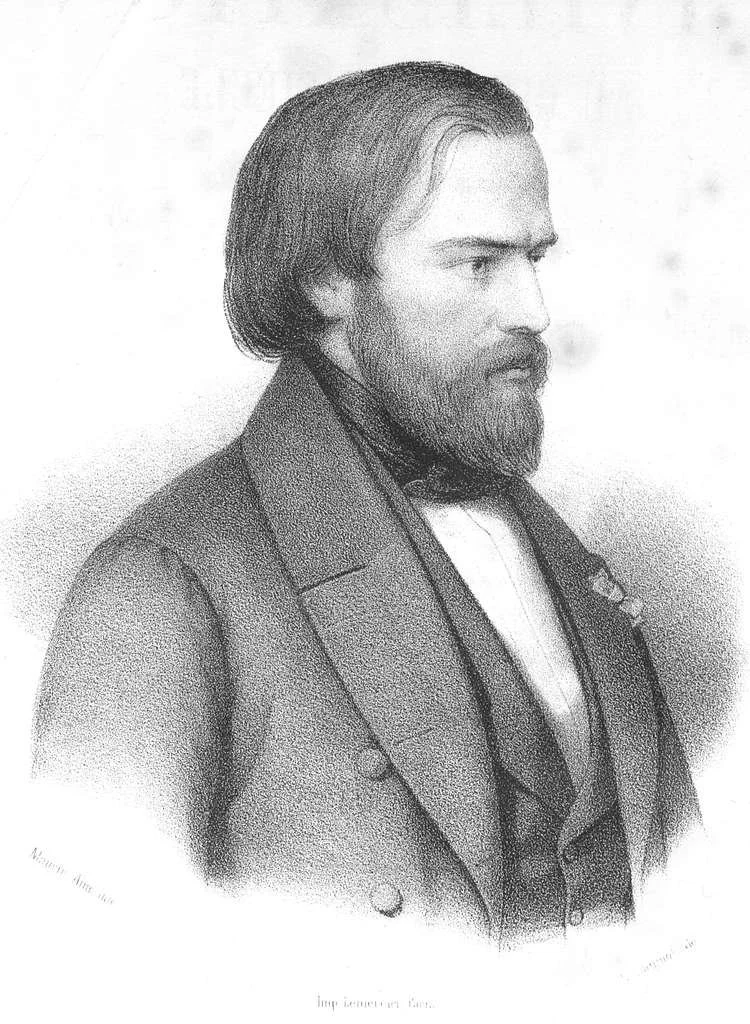
Frédéric Ozanam in 1852 by Louis Janmot. Public domain, via Wikimedia Commons
the greatest of these poets, the blessed Jacopone of Todi, despised as a madman, punished as a criminal, and, from the depths of his prison, thundering with his satires against the betrayals of clergy and people. At the same time, he was not afraid to address in poetry the most difficult points of Christian theology; and, having reached the last depths of mysticism, he already has the accent of Saint Teresa [of Avila] and Saint John of the Cross.
To Ozanam goes the credit for rescuing Jacopone from obscurity and bringing him to the attention of both the literary and religious world, especially outside of Italy.
Nevertheless, at the end of the 19th century it seemed that the Church’s actions had succeeded in substantially destroying all memory of the real Jacopone. Nothing remained of him but the mockery of both clericals and anticlericals, for once in agreement in their prejudices.
But our story doesn't end there... because as the Italian expression goes, ‘il diavolo fa le pentole e non i coperchi’: the devil makes the pots but not the lids.
To be continued…