Notre Dame and Todi
Notre Dame is rebuilt!
I remember the dreadful images of the roof and spire on fire. I felt sorrow, having visited and admired the cathedral in decades past. It surely is one of the greatest artistic and architectural accomplishments of man. Would it be rebuilt? Could it be rebuilt?
Six weeks after that April 2019 conflagration I boarded a one-way flight from New York to Rome. I needed to rebuild after a type of conflagration in my own life. I found my way to Todi.
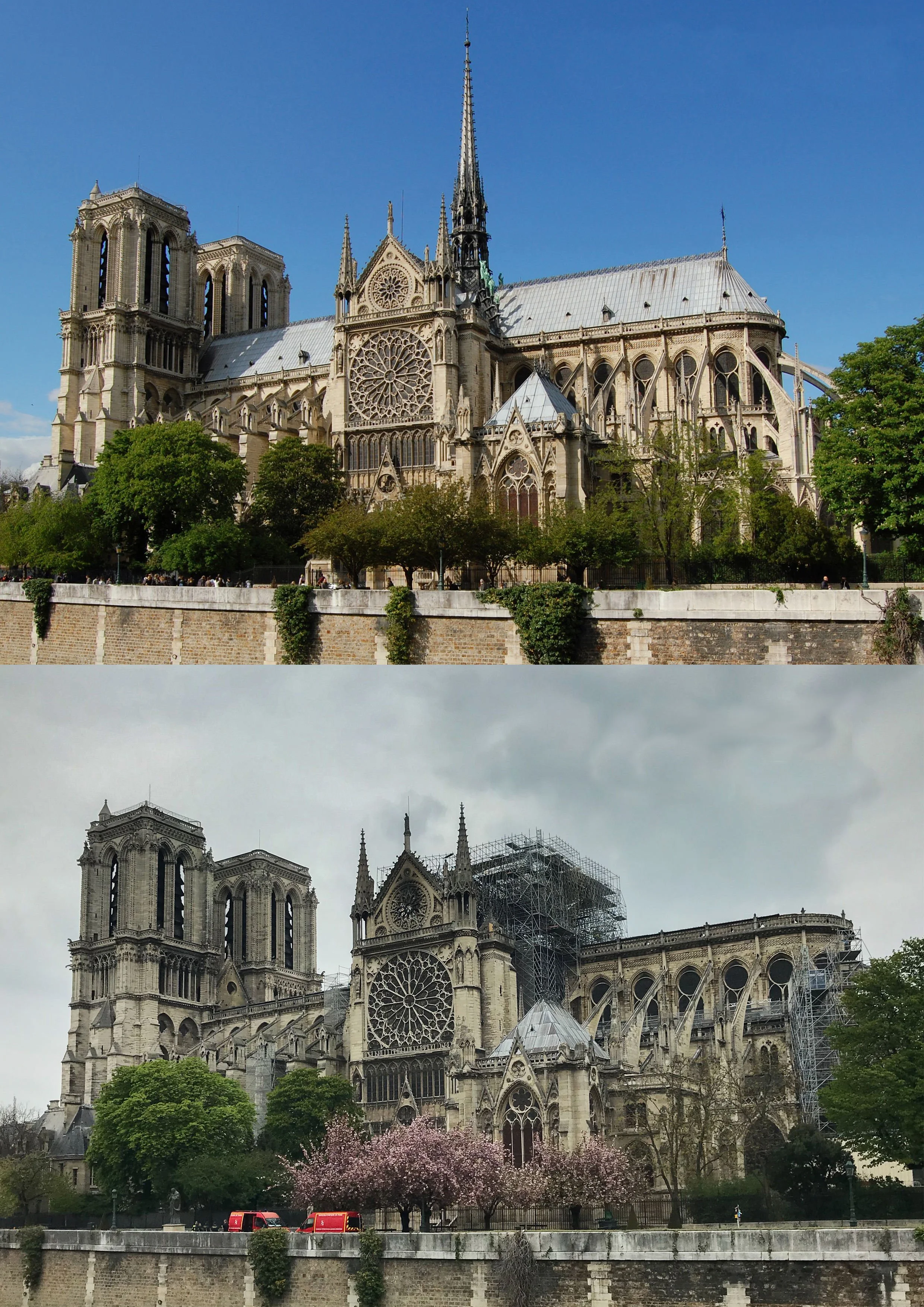
Notre-Dame Cathedral before the fire (above) and after the fire (below), 2019. Photo by Zuffe y Louis HG, Creative Commons CC BY-SA 4.0, via Wikimedia Commons.
I am an architect and builder. I think a lot about what we build and how we build it. I am deeply moved by the majestic grandeur of Notre Dame and the timeless humanity of Todi’s Piazza del Popolo, both built approximately eight centuries ago. Some of the buildings in Todi would be recognizable to Jacopone, if he returned today. The buildings we build – the worthy ones – outlive us, often by centuries. The unworthy ones disappear without notice or care.
Something has been afoot in the design world since the mid-twentieth century. Call it “Modernism,” which is an evangelical doctrine that all new structures have to declare a definitive break with the past. No proportions, no geometry, no materials or craft from the compendium of building history can be tolerated. Every building is a signature of the designer’s ego, not a graceful contribution to the fabric of its context. I see it frequently on the peripheral streets of Rome and in other places ... buildings, like hair shirts, that make me itch.
I am not opposed to modern architecture, but I recognize the extraordinary challenges of siting, designing, and executing it effectively. Many of my favorite buildings are intensely modern: Calatrava’s Oculus at the World Trade Center in New York, Frank Gehry’s Pritzker Pavilion in Chicago, Richard Meier’s Jubilee Church in Rome. These buildings are exhilarating masterworks in stand-alone settings ... with unlimited budgets.
Architecture students are taught that they should design structures as avant garde as these, but most architecture students will never see a site or budget that would enable such an inspired modern vision. What we end up with instead are disjointed “clever” eyesores that pollute our landscapes and dis-harmonize our cities.
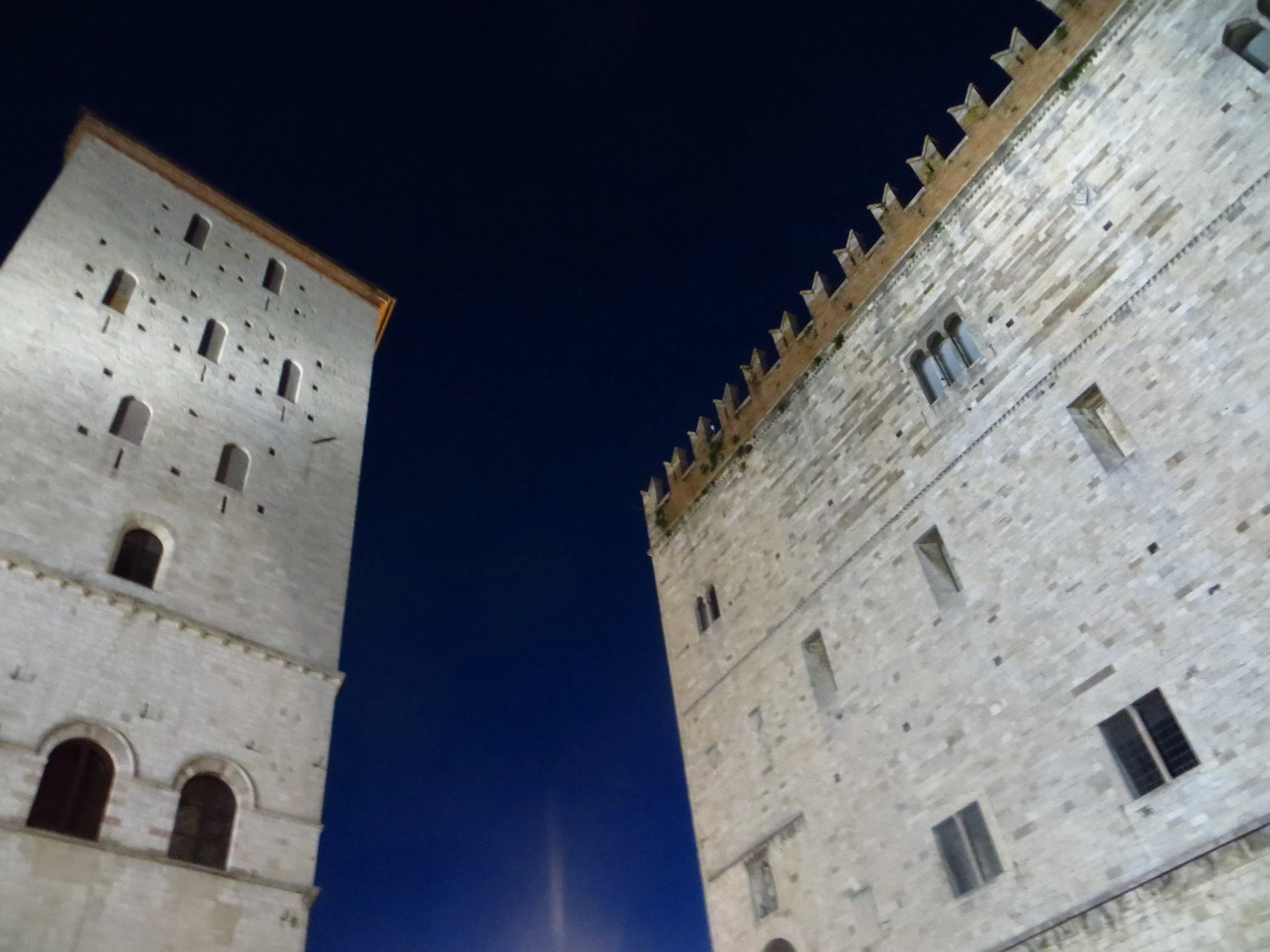
Piazza del Popolo, Todi. Photo by Andy Halpin.
I walk down Via Ciuffelli in Todi’s centro storico. There are no modern masterworks and no clever eyesores. Something else is afoot which is not taught in architecture schools – a timeless stage set.
All of the surfaces of this stage set, save the windows and doors, are of stone. The proportions of the street (width to height) provide a sense of semi-enclosure and safety. The building details are pleasant, with ornamented windows looking over the street. The acoustics reflect off the stone and amplify the actors’ dialogues. The storefronts and restaurants further animate the dramatic stage set. Enter the actors: solos, romantic couples, mothers with children, elder friends, and hoards of teenage school kids. The street comes alive! Italians are famously animated and Via Ciuffelli is their stage.
I have intimate experience with this. My previous bedroom had two windows: one looking out on Via Ciuffelli; the other onto the San Fortunato scalinata. The melodic cadence of Italian life – morning, midday, and into the night – wafts in from both windows.
Every elected and bureaucratic official in Todi and other historically intact places knows what evades the cult of modern architecture: That the historic fabric of their communities is precious infrastructure that needs protection from the errant intentions of clever modern designers. A failure to guard against them can have lasting consequences – a visit to Spello’s Piazza della Repubblica makes this painfully clear.
Within a historical context this is neither normal nor healthy. Never, in 25 centuries, until the last 80 years, have we had to guard our historic communities against the spoiling effects of misbegotten “modern” visions. Historically, architects and builders knew their place in the continuum of civilization. They understood through their visions and craft that their work was part of the fabric of community. It must have given them great joy and satisfaction to make an enduring contribution to that fabric.
In this time we have mostly forgotten how to do this ... and so we must guard our historic districts as a shepherd guards his flock.
I go to the center of Todi to lift my spirits through the inspired proportions of builders long past, and the joyful animation of inhabitants long present. Soon, too, I will go to Notre Dame to gaze upon the buttresses, vaults, and stained glass windows that France has now shown the world we have not forgotten how to build.