Laude XLVIII: O Signor, per cortesia, manneme la malsania / ‘O Lord, please send me disease’

Detail from Pieter Bruegel, ‘The Triumph of Death’ [Photo: Priscila Costa (Ministério da Cultura)/Bearbeitung: Christoph Waghubinger (Lewenstein), CC BY 2.0 < https://creativecommons.org/licenses/by/2.0>, via Wikimedia Commons].
This is perhaps the most intriguing, most provocative and most misunderstood of all Jacopone's laudi. At first glance, it seems to be the prayer of someone who asks God to punish him with all kinds of painful and disgusting diseases, because he is conscious of his great sinfulness. And most people, including most scholars, have seen it this way, even interpreting it as evidence of Jacopone’s hatred for his own body. But when you really think about it, this view doesn’t stand up.
Is Jacopone really praying to God in this laude?
This seems unlikely, for many reasons. Even in the opening line, the expression ‘per cortesia’ is not normally used in prayer. And the notion of asking God, in prayer, to send diseases does not sit comfortably with any Christian view of God’s nature. But more importantly – if Jacopone was really praying for painful disease and a miserable death, why does he take this to such exaggerated, almost comical lengths? He goes to excessive lengths, listing over thirty different conditions, including cancer, blindness, deafness, muteness, paralysis, tuberculosis and practically every other disease known to medieval medicine. Obviously, this is far more than is necessary to ensure misery and an early death! The whole thing has a clear element of playful exaggeration, even of mockery: it’s so delightfully excessive that it’s hard to take it at face value. If someone was truly looking for a miserable death, he wouldn't waste time compiling a complete and detailed list of all the diseases that could destroy him! Jacopone rounds off the laude with biting mockery of those who might seek for relics and miracles (as evidence of sanctity) after his death – again, not what might be expected from a pious medieval exercise in prayer.
So if this laude is not really a prayer, what is it?
Of all scholarly discussions, Estelle Zunino, in her unsurpassed 2013 book on Jacopone, best places this laude in the right perspective, at least on a literary level. She writes that:
The body, as a symbol of evil and sin, is the object of representations so repugnant as to provoke in the reader a feeling of disgust and horror.
That’s it! Jacopone wants to provoke in his readers feelings of disgust and horror – for sin. Rather than being Jacopone’s prayer to God, this laude presents the desperate voice of a kind of ‘generic sinner’ who is shipwrecked in evil, experiencing hell within himself and is suddenly struck, with horror, by the awareness of his own guilt.
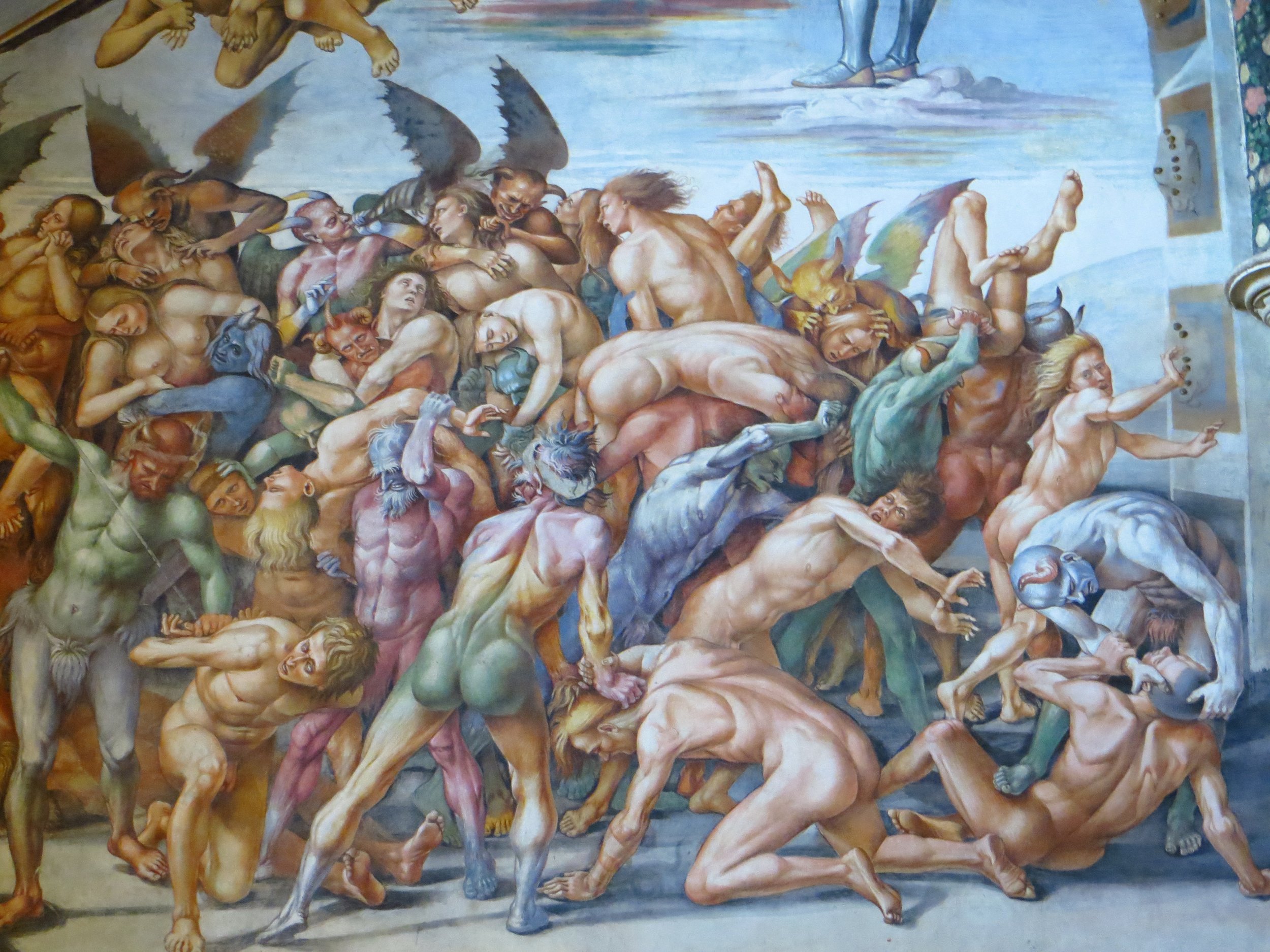
Luca Signorelli, ‘Last Judgement’, Orvieto Cathedral, 1499–1503. Photo by Andy Halpin.
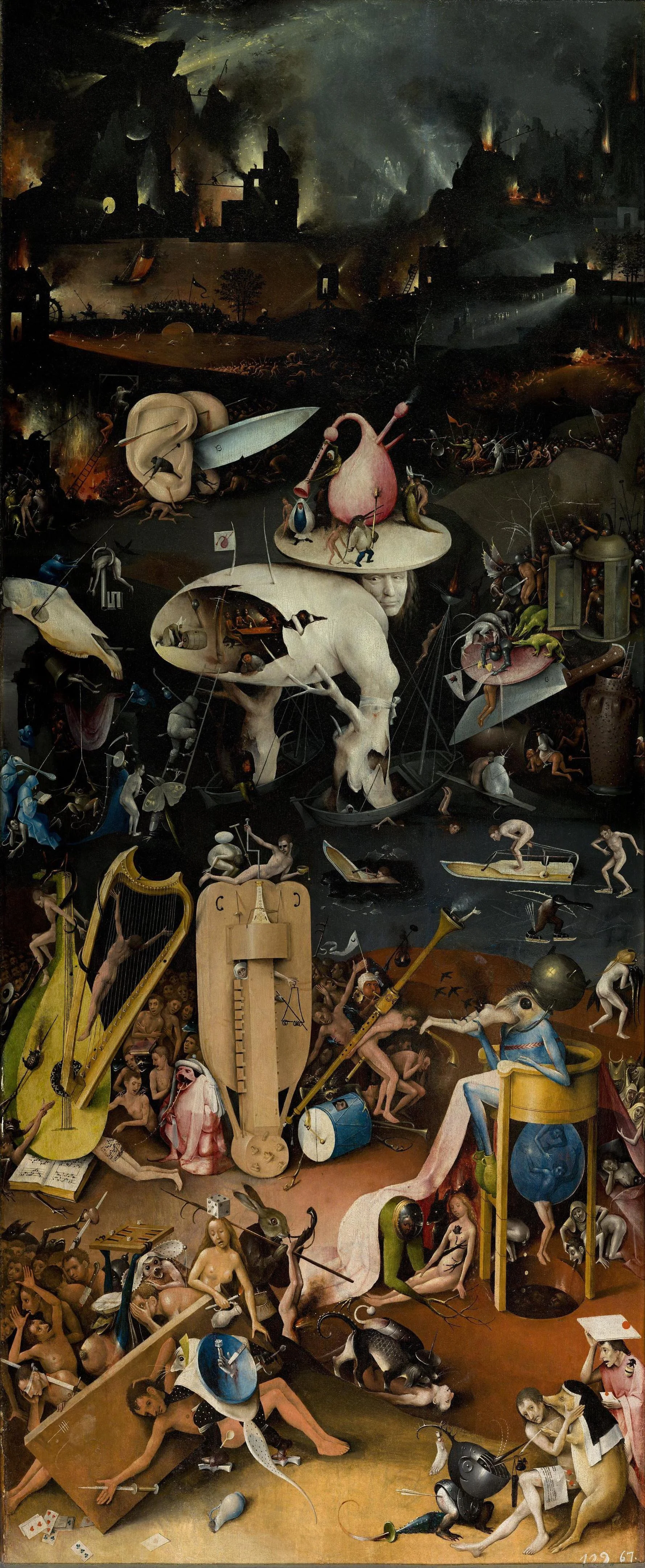
Hieronymus Bosch, Hell: Panel from ‘The Garden of Earthly Delights’, c1480-1505, Museo del Prado [Public Domain via Wikimedia Commons].
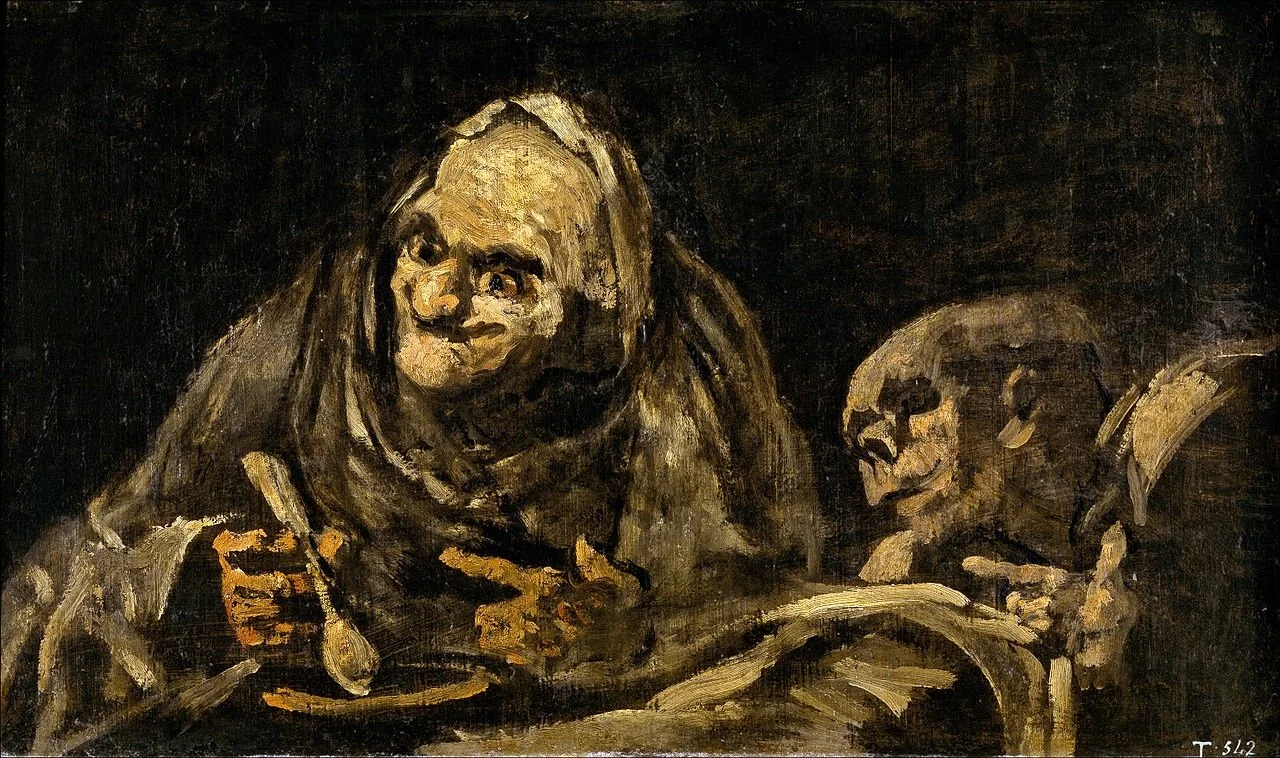
O Signor, per cortesia can, in fact, be seen as an early example of what is called the “art of horror”. It’s usually used today for entertainment (horror movies being the obvious examples), but artists of the past used the “art of horror” for moralistic and religious purposes. There are examples in the Inferno of Dante’s Divine Comedy and in Luca Signorelli’s stunning Last Judgment (1499–1503) in Orvieto Cathedral. Hieronymus Bosch’s Hell (1490s) and Pieter Brueghel’s The Triumph of Death (c1562) are other examples. Goya’s ‘Black Paintings’ (1820-23) are secular examples.
Perhaps we should approach this laude as a poetic version of a Bosch or Brueghel painting, rather than with a simplistic literalism? Isn’t it conceivable that Jacopone, by lining up all known diseases and trying to place them in horrible situations and places, was practicing the “art of horror” much like Goya, Bosch, and Signorelli? And since he was gifted with a strong sense of irony, perhaps he amused himself by imagining the faces of future readers and cultured commentators on this laude (including those of today), who are impressed by the horrid list and the macabre scenes and draw quite inappropriate conclusions about Jacopone's feelings.
This aesthetic approach is valuable, but does not fully explain this laude: Jacopone was never interested in aesthetic exercises for their own sake. His poetry always has a personal, moral or didactic motivation. Perhaps the laude reflects Jacopone’s feelings about the brutal crimes of his time, which were just as vicious and just as frequent as in our day. Our media report daily about someone stabbing his girlfriend to death, or young people, caught up in drug trafficking, being killed by rival gangs, or other violent deaths. I also think of pilots who get up in the morning, shave and shower, and then go off to drop bombs, causing hundreds of deaths, thousands of injuries and unlimited despair: strangely, the media never interview them. And I wonder: if these people were at some point struck by a glimmer of light and realized the horror and pain they have caused, how could they address God? How better than with the words of Jacopone in this laude...?
We invite you to read the full laude O Signor, per cortesia, manname la masania/ ‘O Lord, please send me disease, with translation in English here and in Italian here.
Did Jacopone hate his body?
Several writers have discussed Jacopone’s contempt – even hatred – for the human body and his own body in particular, quoting this laude as a prime example. Even the most recent discussion of this laude by Alessandro Vettori, a fine scholar and admirer of Jacopone, repeats this. But is this is an over-simplification that does not do justice to Jacopone’s views?
He certainly believed in the need to discipline his physical desires and urges, often through penitential practices – but that is very different from hatred or contempt. As he himself says in laude XXXVIII (‘O megio vertuoso/Virtuous middle ground), l. 37:
Who ever heard of doing oneself good by hating oneself?
[de farme bene en odio / or chi l’odi mai dire?
This laude XXXVIII (‘O megio vertuoso/Virtuous middle ground) is entirely devoted to the difficulty of finding the ‘virtuous middle ground’ of spirituality, steering a path between excessive indulgence on one side and excessive discipline on the other – between the demands of charity and holiness and the temptations of judgmentalism and self-righteousness. And in laude III (Audite una 'ntenzone/Listen to a dispute), Jacopone provides a thoughtful discussion of the need to find a balance between the temptations of the body and the inspirations of the soul. All of this is a far cry from a simplistic hatred of the body!
Laude XLVII (Or udite la battaglia/Now listen to the battle) is even clearer about the need to apply penitential practices in ways that respect the basic needs and health of the body. Remarkably for that period, Jacopone condemns penitential excesses as demonic temptations and in lines 35-37 responds to the devil:
Hypocrite, I’ll nourish my body, not kill it!
[Falsadore, eo notrico / lo meo corpo, no l’occido:]
I will nourish my body, which helps me to serve God
[Eo notrico lo mio corpo, / che m’adiuta a Deo servire]
This echoes another verse (lines 39-42) in laude XXXVIII (O megio vertuoso/Virtuous middle ground), where Jacopone talks about how fasting can “keep this donkey [i.e. his body] from getting out of line” – but in the very next breath adds, “yet I want my body to be strong, so that I can persevere in penance”.
Vettori refers to the excesses of some mystics of Jacopone’s time, including those who practiced “holy anorexia”. And undoubtedly medieval piety did, too often, degenerate into unhealthy ascetism and negativity about the body. But all the evidence indicates that Jacopone did not share such ideas – in fact, compared to some of these extreme examples, Jacopone comes across almost as a model of healthy balance!